
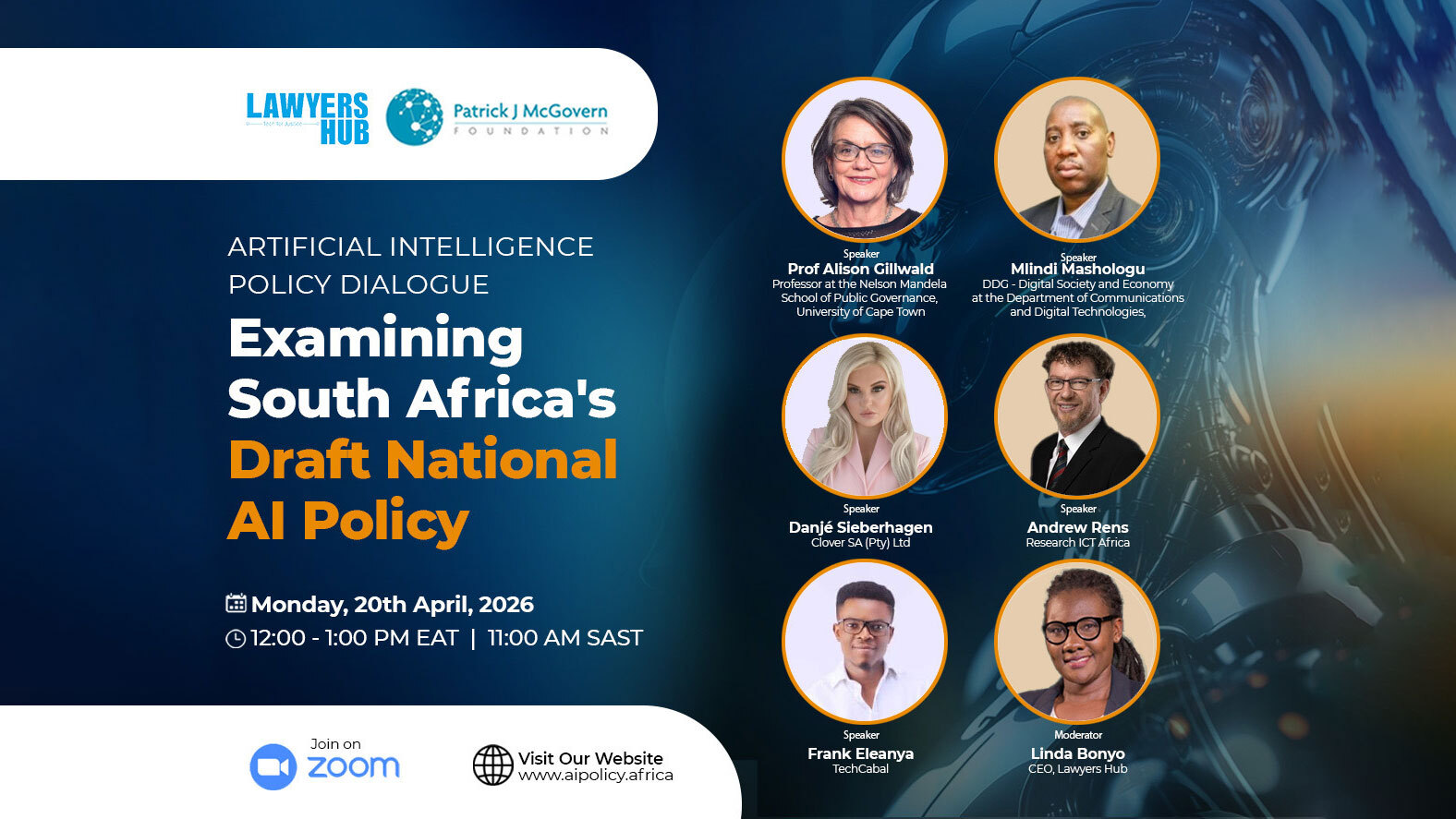
South Africa has officially released its Draft National Artificial Intelligence (AI) Policy, marking a pivotal moment in the continent's digital governance. To dissect the mechanics of this landmark framework, Lawyers Hub recently hosted a dedicated Artificial Intelligence Policy Dialogue. Moderated by Lawyers Hub CEO, Linda Bonyo, the panel brought together leading voices including Prof. Alison Gillwald, Mlindi Mashologu, Danjé Sieberhagen, Dr. Andrew Rens, and Frank Eleanya.
The consensus? South Africa has proposed the most elaborate AI governance architecture on the continent —but bridging the gap between bureaucratic ambition and practical implementation remains a profound challenge.
The New Oversight Architecture: Ambition vs. Reality
The draft policy is unprecedented in its institutional scope, proposing the establishment of seven entirely new oversight bodies. This includes a National AI Commission, an AI Ethics Board, and an AI Regulatory Authority. Most notably, it introduces continental firsts: an AI Ombudsperson Office for citizen redress and an AI Insurance Superfund designed to compensate individuals for AI-driven harms.
However, the panel quickly identified a massive implementation risk: none of the four distinct financial vehicles named in the policy—including the highly anticipated AI Innovation Fund—are costed, sourced, or fully operational. As highlighted during the dialogue, proposing seven new institutions simultaneously without a clear funding model leaves these vital oversight mechanisms at risk of remaining purely aspirational.
The Compute Gap and the Open Source Imperative
A thriving digital economy requires more than just regulation; it demands infrastructure. During our session, the debate strongly pivoted toward the necessity of open-source ecosystems for local innovation. Dr. Andrew Rens pointed out that open-source models enable local developers to test systems, interrogate algorithms for bias, and build sustainable solutions.
Yet, the reality for African startups is stark. Despite the policy's promises of grants and tax breaks , local AI ventures are currently hindered by a severe lack of compute capacity and high barriers to foreign exchange. Unlike other regional models that offer concrete compute-credit schemes, South Africa's startups are left waiting for a fully resourced ecosystem.
Anchoring AI in Ubuntu: The Push for Algorithmic Sovereignty
Perhaps the most philosophically profound element of the draft policy is its attempt to embed Ubuntu as a core governance lens. The policy dictates that AI systems must serve the common good and respect human dignity.
However, researchers argue that Ubuntu must do real governance work. South Africa cannot risk becoming a perpetual exporter of raw data while importing foreign-owned insights. As Prof. Benjamin Rosman's insights highlighted in our brief, we must build our own "algorithmic refineries" to achieve true algorithmic sovereignty.
The Window for Action
The window for civil society, industry leaders, and legal practitioners to shape this framework is rapidly closing. The public comment deadline for the draft policy is June 10, 2026. We urge all stakeholders to review the document and submit their formal feedback.
At Lawyers Hub, we believe that shaping Africa’s digital future requires continuous, collaborative dialogue. Join us every Monday as we host vital tech policy discussions focusing on the evolving digital rights landscapes of different African countries.
Missed it? Watch the full recording below.