
Africa is moving rapidly to regulate Artificial Intelligence. Across the continent, governments are drafting frameworks to manage the risks and opportunities of a technology that is reshaping the global economy. Yet, a persistent challenge remains: moving from policy formulation to technical execution.
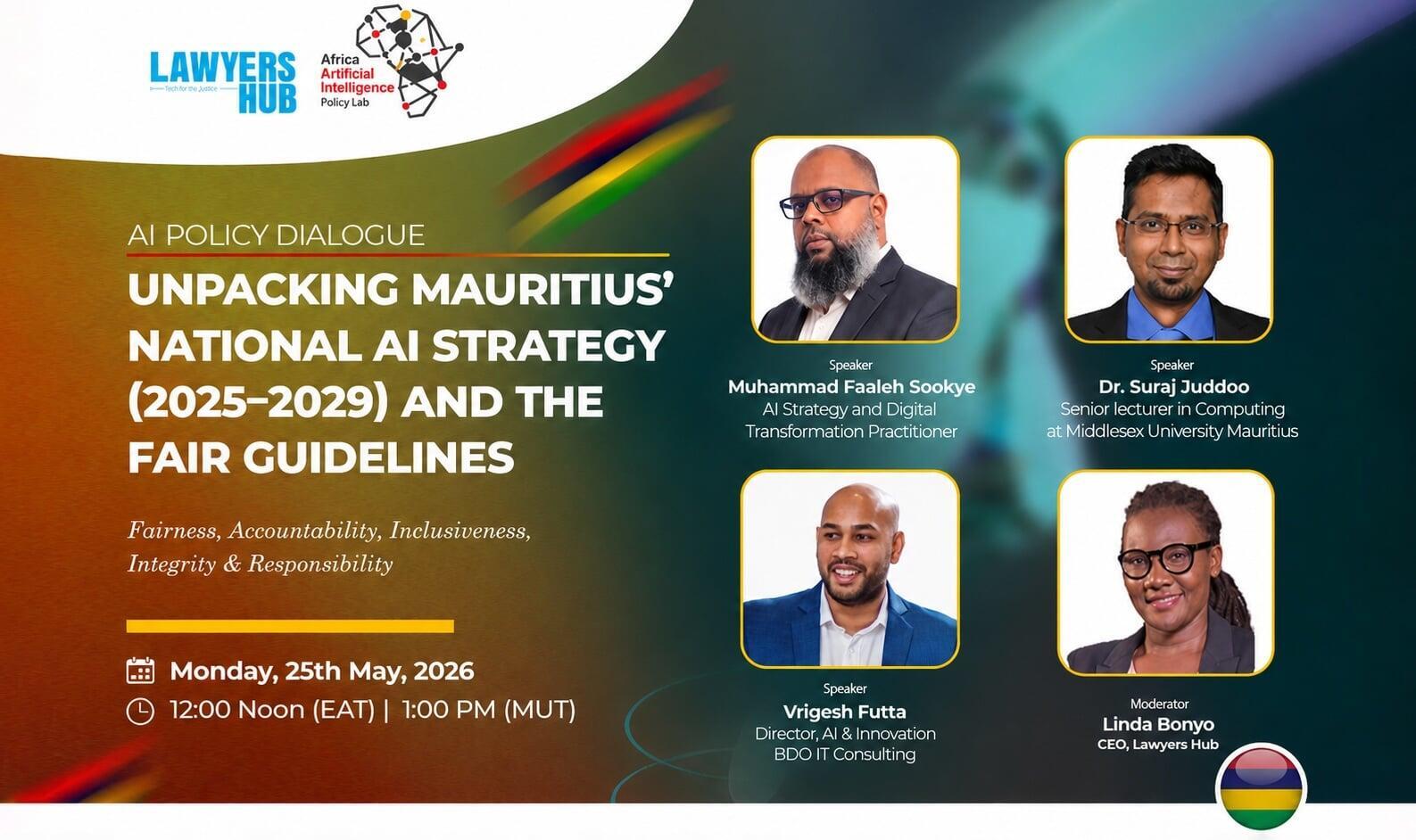
During our recent "Policy Mondays" webinar, Lawyers Hub CEO Linda Bonyo framed this exact challenge as we unpacked the newly launched Mauritius National AI Strategy (2025-2029) and its accompanying FAIR Guidelines. Mauritius has put forward a bold blueprint. The question our expert panel addressed was whether the institutional reality on the ground can sustain the policy ambition.
The Core Framework: AIM, DIVA, and FAIR The Mauritius strategy positions the island nation to transition from basic digital readiness to true digital intelligence. A standout feature of this transition is "DIVA," a 24/7 citizen virtual assistant designed to interface directly with the public.
To govern these new capabilities, the government introduced the FAIR Guidelines. Grounded in Fairness, Accountability, Inclusiveness/Integrity, and Responsibility, the guidelines establish a risk-based ethical framework to manage AI deployment safely.
The Reality Check: SME Readiness and Implementation While the policy documents are comprehensive, the operational challenges are steep. Muhammad Faaleh Sookye, an AI Strategy and Digital Transformation Practitioner, highlighted the significant gap between the government's ambition and private-sector execution. He pointed out a stark reality: roughly 70% to 75% of Small and Medium Enterprises (SMEs) in Mauritius are still in the basic digitization phase.
For these businesses, AI cannot be an afterthought bolted onto legacy systems. Sookye stressed that if the FAIR guidelines are to be effective, they must translate into practical, day-to-day implementation decisions for these SMEs, rather than remaining high-level, theoretical governance documents.
Compute Costs and the Question of Digital Sovereignty Another critical hurdle is infrastructure. Dr. Suraj Juddoo, Senior Lecturer at Middlesex University Mauritius, offered a candid assessment of the country's position in the global tech hierarchy. Mauritius, he noted, is fundamentally an "AI adopter" rather than a producer.
While Dr. Juddoo praised the strategy’s alignment with the national digital blueprint, he pointed out critical gaps in the framework. The strategy currently lacks precise monitoring mechanisms, defined budgets, and clear institutional ownership. Furthermore, it misses a crucial discussion on "AI Sovereignty." Dr. Juddoo emphasized the staggeringly high costs of compute power and GPUs, which present a heavy barrier to local innovation. He also noted that for the FAIR guidelines to hold weight, Mauritius needs updated data protection laws to support them.
Attracting Investment in the AI Race Despite these hurdles, Mauritius has distinct strategic advantages. Vrigesh Futta, Director of AI & Innovation at BDO IT Consulting, situated the country within the broader African and global AI race. He argued that Mauritius must leverage its highly regulated, strong financial systems and stable jurisdiction to attract foreign AI investors, international tech companies, and research institutions. To win this race, however, Futta called for a strict focus on operationalization and clear timelines.
Mauritius has laid the groundwork. The policies are published. Now, the real work of building an equitable, sovereign, and well-resourced digital economy begins.
Watch the Full Replay Below.